
01.03.2011.
Interview with Col, Marijan Novakovic, MD, prof., new Chief of the MMA
MAN OF CONTINUITY
- I often say that we clinicians to use, so to speak, seem to have forgotten to use our hands so we would not be considered conservative. But you have to talk to a patient, get a lot of data from his medical history and physical examination, and only then use additional diagnostic capabilities, since diagnosis is a sort of a black box for us
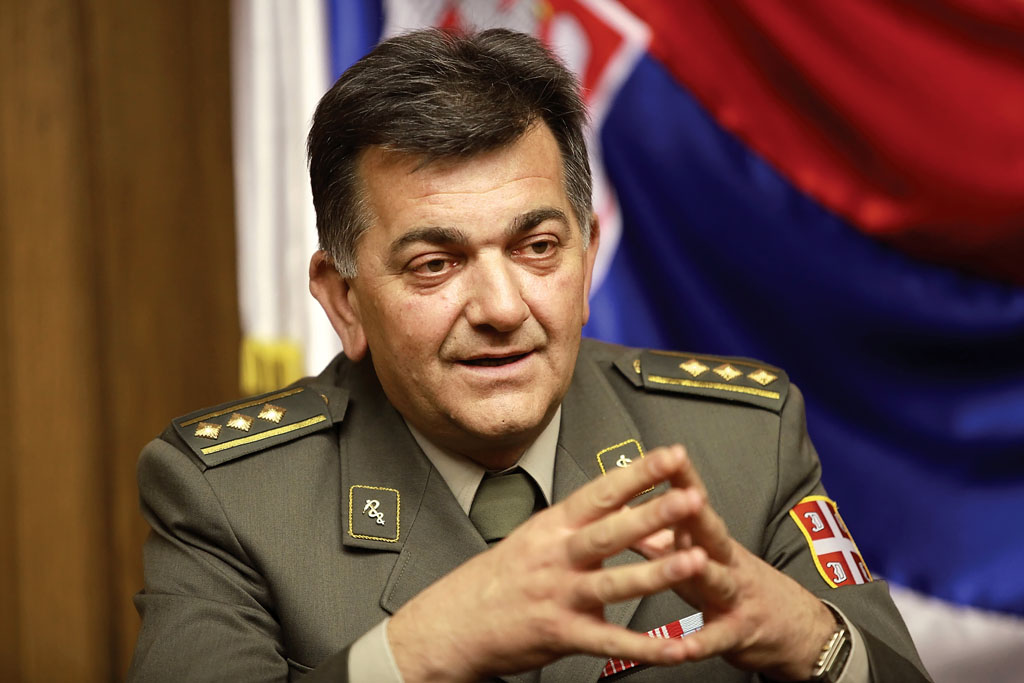 Colonel Marijan Novakovic, MD, professor has recently been appointed the new chief of the MMA. Those who know him well would say that he is hard-working and dedicated work, an expert in what he does, blessed with a researcher’s spirit, who has a discreet touch of charm when treating a patient, attentive and caring towards patients and in many ways a positive personality, loyal to the profession and his family.
 In his life both the military and medicine intertwine. He graduated from the Military High School, was awarded military scholarship for the studies at the Faculty of Medicine in Belgrade, then graduated from the School of Reserve Officers in medical services and he found himself in the MMA from the first days of his medical practice. Here he started an obligatory medical internship, residency in Plastic and Reconstructive Surgery and at the Department of Plastic Surgery and Burns, MMA he has remained to this day. He was appointed Head of this department in 2007.
He performed the most complicated surgical procedures in almost all areas of Plastic, Reconstructive and Aesthetic Surgery. The wars in former Yugoslavia and the large number of injured led him to focus on practicing and perfecting the microsurgical technique, and in that area he defended his PhD thesis in 1998. He has been a tenured professor of Plastic Surgery since 2009, has written more than 200 research papers, wrote two books and co-author one, is a lecturer at a number of faculties in the country ... He has received honors, commendations, and was the first to be awarded the White Angel medal.
Professor Novakovic, becoming the Head of MMA is just another rung in your military career ladder. Do you have the strength, determination and courage to lead this institution forward in the coming years?
- I think that those who enter medicine must have the strength, desire, will and courage for a lifetime. I was lucky enough to start my medical practice at MMA just after graduation and I have stayed there until today. In this institution I have made all technical and scientific achievements and they are my endless source of energy and courage. They taught me to be persistent in everything, and they will the same source for my role as the Head of MMA. Surgery is an filed because which has perfected my mind making it more sharp thus giving ,e courage for everything else in life I hope that my coworkers, a team of experts from various fields, will support me and give even greater energy to persevere.
You are a plastic surgeon and your area of expertise is reconstructive surgery. So, once again we have another surgeon as the head of the MMA. Is it this a coincidence or a form of recognizing your surgical school, which, unfortunately, emerged as an expert one during the wars in 1990s?
- As a surgeon I think it's justified, and that this is no coincidence. We are contemporaries of these unfortunate events in former Yugoslavia and the unfortunate civil war during which left a large number of injured who were successfully transported and admitted to MMA. Hippocrates once said that the only true teacher of surgery is war, unfortunately, we had the opportunity to experience it and undergo this type of training and gain experience. Therefore, the MMA surgery deserves the merit. It is a leading surgical school and we can tell the it is a dominant branch of medicine that is constantly expanding, and our institution is well- known and recognized by surgical schools abroad..
Surgery is based on a solid organization and surgical skills. Are these principles the basis for your future work?
- Surgeons are rational, concrete and precise. With all that surgery has to have double hierarchy than the military, because if there is no order from diagnosis to the completion of surgery, this can cause serious problems. I'll do my best and I hope that I will implement precisely this rationality, practicality and a sharp mind that surgery has taught me.
Is this double hierarchy you are mentioning something that distinguishes the MMA from the other civilian medical institutions?
- I have to admit that we probably have a slight advantage over civilian hospitals and I think it is very important to respect the hierarchy in medicine. It is, however, present everywhere in the world. A respect for hierarchy, in a military organization is a prerequisite for successful operation, growth and development of such megasystem such as the MMA.
Last year was very successful for the MMA, by some estimates the best in the last ten years because the level of health services increased by an average of 15 percent. Many say that this treatment contributed to the large number of civilians with the primary health care referral lists of the Republic Health Insurance and one day a week when your ER center is on call. What do you think about these assessments?
- In any case, they are correct. The work of all physicians and all employees of the MMA, responsible for treatment, was greatly facilitated by the cooperation that exists with the Republic Institute for Health Insurance, because we are able to treat virtually a very large number of civilians insured, with appropriate referrals. Introducing emergency Wednesday, our emergency center became an on call ER for the entire Republic. Again we have pathology in all areas of our specialization as in those times when patients from all over former Yugoslavia were treated at MMA, and when the training of junior staff was much broader and better. I hope that this practice will be better and that the cooperation with civil Institutes continues to improve.
Normally, we must not forget that we are tertiary level institutions so that we have to make a selection, and that MMA treats very difficult and complicated cases from all over Serbia, especially in the field of complex injuries, transplantation surgery and in all segments individual specialization.
As chief of the Department of Plastic Surgery and Burns you have seen what an urgent state looks like. How did you manage to take care of many patients?
- In the beginning we were all excited and we were nervous. However, since the first day until now, everything is going better. At the clinic we have a drastic increase in the number of admitted patients, especially with burns and traumas and major soft tissue defects. Previously one doctor on duty would treat five to six cases, while on emergency Wednesdays, of Wednesday, we had between 25 and 30 injured admitted. A plastic surgeon on duty treated the admitted patients. Specifically, on that day we placed on call two additional specialists, and increased the number of anesthesiologists on duty, instrument technicians and all the staff in the surgical domain and the other branches of medicine. In addition, we had to vacant all unnecessarily occupied beds in a timely manner so we could admit all the injured and patients requiring hospitalization. It must be planned and we have to take this into consideration, which practice we hope to continue.
The analysis of the MMA has shown that it is in 2010 more civilians than military insurance policy holders were treated. Is this a coincidence or has it become a rule?
- Not at all. Military policyholders have priority, especially those with indications for the tertiary level of health care. We are primarily a military health facility, but let me remind you that the MMA once covered all of Yugoslavia when there were many more military insured personnel and their families. Now in the new circumstances we did not want to deprive our free civilian health care facilities. The contract with the said Institute has enabled the MMA to formally become what has always been the hospital at the disposal of the citizens of Serbia in which priorities are defined based on medical indications. We are ready and we will always accept cooperation agreements between the two ministries – that of defense and health.
There has been a lack of medical personnel with only secondary education for a very long time now. Is there any chance that this issue be resolved?
- It's not just our problem which exists in all clinical centers in Serbia and I hope we will solve it eventually. WE have already finished with one admission cycle, at a meeting at the Ministry of Defence I was informed that we can relatively quickly plan other admission processes. I hope we continue to have at least two such admission cycles a year. We must work fast because every young nurse and technician should take time to learn from older colleagues in order to achieve continuity in the work of the staff, which is extremely important from the time when a patient is admitted until his treatment is completed, and I believe that this should be an ongoing process.
Education of doctors is also important. Although passing the specialist examinations is extremely important to a newly formed doctor, he is not yet a fully-fledged doctor, who can work independently, he would have to be supervised by his mentor for a certain period of time, where the real things are happening and serious illnesses are treated. It is dangerous if you have a big generation gap between doctors. We need to establish continuity in the education of new specialists and the training, for sure.
Will you start the practice of not sending doctors only abroad but to other health institutions in the country as well?
- Of course we hope to do so, even during their residency. The specialists in the field of surgery I practice have excellent cooperation with universities in Belgrade, Novi Sad, Nis, Kragujevac. It was not difficult to agree on amending the specialization programs, because now we have to fit into the school system. The first man of the plastic surgery in Nis, the colleagues from Belgrade, Novi Sad, and I, as president of the Association of Plastic Surgeons of Serbia, made a proposal which is to be adopted by the medical school association, so as to make the specialist studies in plastic surgery a uniform module for all plastic surgeons in Serbia. We agreed on the duration of studies and the skills that young doctors in the specialization have to see, learn, and practice. They will be able to spend part of that specialization in any of these centers in the country, with an appropriate mentor, determined by the institution. Practically, the doctor will be specifically guided starting from his first day and after passing the qualification exam in Serbia in the European board of plastic surgeons will be able to work equally. I will try to make this a model that will be applied in all fields of medicine, as part of the excellent cooperation MMA has made with all the clinical centers and medical schools in the country.
As for sending doctors abroad, we will send certain young and ambitious doctors eager to learn. Our goal is for them to be able to apply these newly acquired skills in treatment and as an innovation at the MMA.
Technological renewal is another priority of the MMA. What do you plan to acquire in the future?
- The MMA have always sought to ensure that there are more sophisticated diagnostic procedures that would mean acquiring modern equipment for faster and better diagnosis. This is a continuous process that helps doctors, researchers and clinicians who contribute to achieving the best results of treatment, research ...
In the previous period, with the support of the Ministry of Defence, a lot has been purchased. We bought a new MRI, scanners of all types, an angiography room. Another field, intervention radiology is gaining momentum fast both here and abroad, and many things can be done almost in the conditions provided by the outpatient hospital. This considerably shortens the time of treatment and the overall treatment of severe pathological conditions. WE should soon put into operation the hyperbaric chamber and a new accelerator, which will improve radiotherapy in the treatment of malignant conditions. The idea was, and is now at the stage of realization, that each clinic houses besides regular hospital beds a semi-intensive unit with a higher degree of patient monitoring.
All these modern diagnostic technological advances absolutely can not mean much if we do not have the appropriate medical personnel capable of operating them and those who finished medical secondary school. Thus, again we return to the same story that it is crucial to have permanent education, as investing into staff is an investment in the future of military medicine. We do this by educating cadets at our medical school who would continue where we left off as officers and doctors.
Let us mention the research work. For the MMA is a few mega project and sixty sub-projects. When can we expect that the results of application in clinical practice?
- It depends on the field of research. I know that the results in oncology, some inflammatory conditions, particularly in the field of sepsis, which occurs as a result of major trauma are already being implemented. We have many ongoing projects, but we, unfortunately, have the economic crisis on our hands hindering their smooth operation. However, resist. Our advantage is that we have everything in one place, in addition to the dominant clinical part of the MMA, there are institutes and the Institute for Research. I think that the relations between practicing physicians and medical researchers should be even tighter in order to apply the results of the research work as soon as possible in practice.
Last year MMA was visited by 16 delegations at the highest level. What do foreigners want to see?
- Most organizations are interested in our services and military health care as part of our ministry, then the trauma center, because they know, let me remind you once again, that we have unfortunately been in a position to gain extensive experience in war surgery and general warfare medicine. What they also find interesting is the PTSS the posttraumatic stress syndrome in the field of neuropsychiatry.
HIGHLIGHTS:
How important are peacekeeping missions for medical services?
- It is of paramount importance to be able to share and convey our experience and actively participate in all missions. Those skills and knowledge our doctors gain in the field, in some specific situations also count. Furthermore, participation in peacekeeping missions will contribute to raising the reputation of the defense ministry and the state of
Serbia as a whole.
What have you learned from past wars?
- I will launch an initiative regarding the compiling of a new textbook as part of our basic medical studies so as to have war surgery as a segment in the subject of surgery. We will do our best to train our doctors to be true military doctors from day one.
Is practicing medicine passion or business?
- I have always considered it to be passion and a sort of love and I have the impression that most of my colleagues think so. Medicine should be the calling of those who love it and are willing to de3dicate themselves 24/7 and not just forget about everything after working hours.
