02.12.2010.
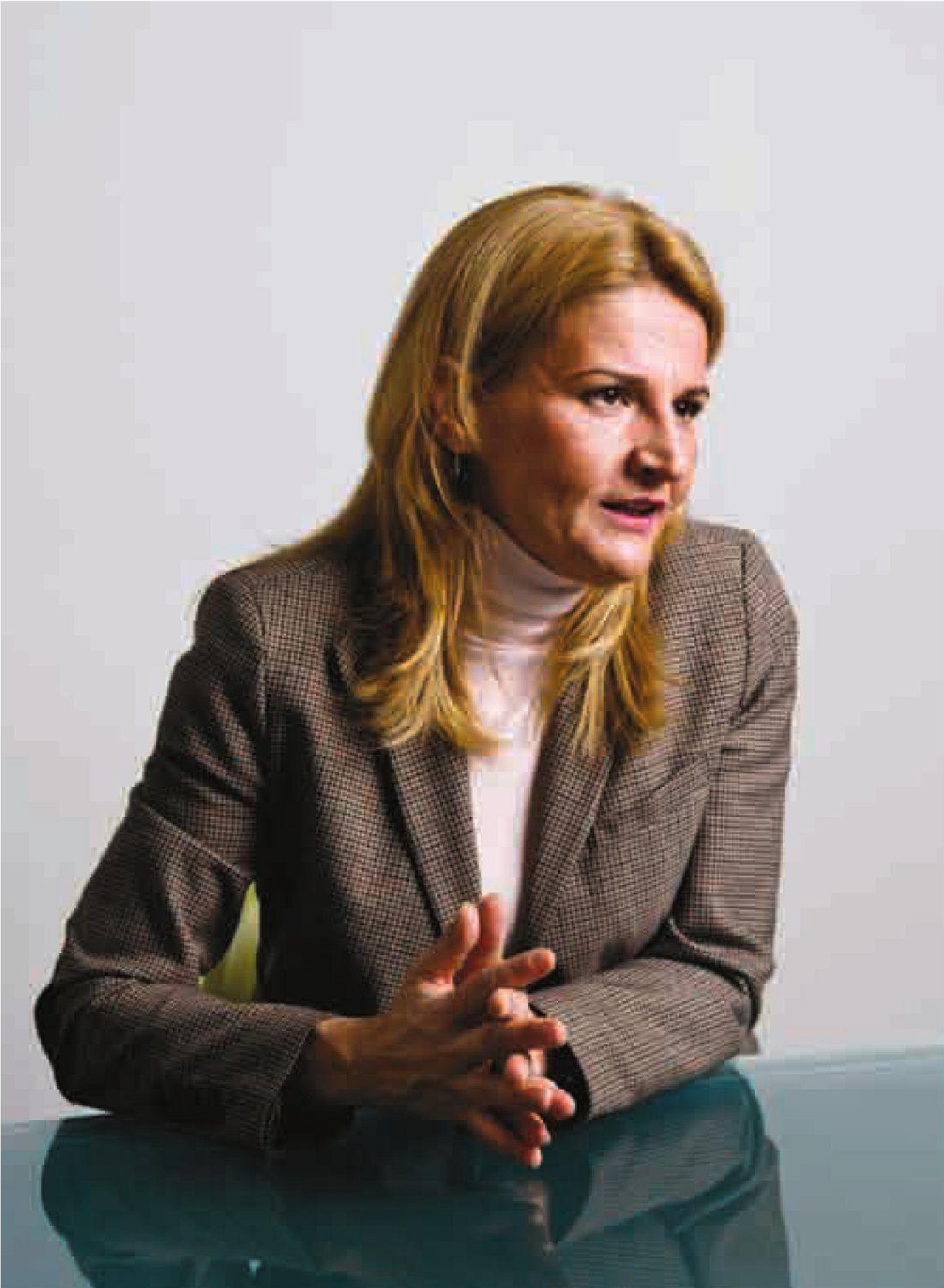
Tanja Miscevic appointed as State Secretary in the Ministry of Defense
 It is possible that by the end of next year, Serbia will acquire candidate status, if we achieve significant progress in ten key points, including the top priority that is full cooperation with the ICTY. The fact that the Serbian government has showed willingness to find a solution to poor reviews for the judicial reform proves that our local political elite is growing up.
It has been less than a month since she was appointed the Secretary of State in the Ministry of Defence, yet Tanja Miscevic seems to support the commitment of Serbia to Euroatlantic integrations with full force and credibility, which have gained momentum since the EU Enlargement Commissioner Stefan Phile presented the EU candidacy questionnaire to the Serbian Prime Minister Mirko Cvetkovic. Former Director of the Office for European Integrations, Tanja Miscevic, in an interview with the Economist magazine, expressed his belief that the civil servants will have responded by the end of January 2011, as promised, to almost 2500 questions. With a simple nod, Tanja Miscevic disperses all doubts as to whether the officials in Brussels will give the green light to Serbia to apply for candidacy next year. The catch would be for Serbia to make substantial progress. "When you read the annual report of the European Commission, it can be concluded that there is no single area that has not started the harmonization process," says the professor of the Faculty of Political Sciences.
How can You be so sure that Serbia will be able to respond to the questionnaire, as announced by our officials and they expect the EU?
Experience in the region has shown that the average time needed for answering the questionnaire is between 3-6 months, but the Serbian administration has started preparations early 2010 preparations for this job Serbia has started responding to the questions that were located in the Montenegrin and Croatian questionnaire.
On the other hand, local administration has been holding talks for a dozen years now with the European Commission and knows how to get the best answers, so you should expect not only fast, but good answers, which is much more important. Therefore, I think the it is possible to meet this deadline.
In what is this test a test of sincerity for the local authorities, as the assumption is that the answers should be honest, because that is the only way of presenting us as a reliable partner?
No, we have not had a problem with dishonesty in answering the European institutions. By doctoring and embellishing answers we would create a problem for ourselves because we have to justify everything in writing and we would stand to lose face.
The questionnaire was neutral regarding the status of Kosovo. How are we to define the limits?
Just as the Constitution defines the borders of Serbia, composed of two autonomous provinces, noting that the region of the southern Serbian province is under the administration by UNMIK adhering to the Resolution 1244 The questionnaire has to be responded by the Serbian administration that has comply with the Constitution of the Republic. On the other hand, the responses are sent to the EC, which is also neutral in status. There should be no problems in finding consensus on how to respond. You are then not defined on how big a country which enters the European Union is. There is still time to determine the borders, this is just an overview of the constitutional, legal and regulatory type of government in Serbia
Do you mean to say that the issue of territory will be on the agenda when our candidacy is discussed?
This issue will certainly remain open during the negotiations and at the time of accession to the EU, but we have enough time by then to find the answer.
How will the answers provide a "snapshot" of the situation in Kosovo when the Serbian administration has no insight into the situation in the province?
Only UNMIK has been informing the EU Commission as well as EU member states of the status of reforms and changes in the territory of Kosovo since 2006 since based on Resolution 1244 Serbia has lost all control overt his territory. The fact that the Serbian Government cannot give orders, frees the Serbian authorities of responsibility for all the reforms in various sectors.
The questionnaire, however, contains a chapter concerning the free circulation of goods. Serbia is expected to allow the free flow of goods bearing the mark of Kosovo. Bearing in mind that Serbia does not recognize the state of Kosovo do you believe that such a thing is possible?
Serbia, together with UNMIK, is one of the signatories of CEFTA 2006. The flow of goods provides a very successful solution for all sides. The novelty is the recognition of Kosovo stamps as such, and not the UNMIK stamp. Now we come to a legal turf, the following dilemma is raised, if UNMIK is a signatory, how can Kosovos’ stamp be recognized which is not a signatory of the same contract. "It is a legal question to which a legal answer must be found The pint is to find a solution to renew the CEFTA agreement.
If Serbia will have to accept the seals of Kosovo, will it have to accept Kosovo passports as valid travel documents?
It is a matter of finding a uniform principle.
Will the questionnaire contain any questions that you did not expect?
For Serbia, the specific issues are those relating to Ethnic Minority Councils, as well as significantly larger portions of the questionnaire related to agriculture. This will be the first time that we have come across some new areas that have not been a priority in Serbia’s relations with the EU such as the security sector reform. For the first time we will have to answer such questions as the number and composition of the military, the process of professionalization in the Serbian Army.
What to do with the judiciary system since the judiciary sector has been reformed, but the reforms have apparently failed to meet European standards. It was said that the EC will send its experts as serious irregularities in the selection of judges have been noted?
The situation where we are right now is that the judiciary system is the second most important of 10 key issues in the obligation to extradite Mladic and Hadzic. The positive thing of the bad rating that our judicial reform has received from the EC is the judiciary’s system to find a solution and get out of this situation. This is an indication that we understand how important it is to discuss these matters however the Serbian authorities still need help the help of the EC.
The reform was carried out by some other criteria, where part-kin-friendship affiliation was crucial.
Those who are responsible for the reform realize that things have to change and improve and are doing their best to find the best possible way to fix these things. The truth is however that there are vested interests which influenced the reform of the judicial system, that the judiciary has made some progress can be seen in the fact that in 2006 the main question was when Serbia will even start to implement the reform, while today the reform process is ongoing.
Does this mean that during the reform "”the functioning of the political system was a more decisive factor than the recommendations of the European Commission?
As in every social reform, this is all about emancipation, growing up of the political elite.
You mentioned the Hague as the top issue, what will ultimately satisfy the EU Commission? It seems that the story of pursuits and those who hide the indictees are not strong enough.
In order to show that there is full cooperation in dealing with the Tribunal it is necessary to locate, arrest and extradite the two fugitives.
These are the standards and nothing short of them will be enough?
In terms of priorities for European integration, it is difficult. Because this is the decision of the Council of Ministers, previously passed, according to which Serbia will be sent a Questionnaire. It should be noted that even when this whole situation with Mladic and Hadzic comes to an end, Serbia will also have to keep the level of cooperation with the ICTY. It is the availability of documents, waivering the right to confidentiality, providing assistance to lawyers of the indictees...
It appears that the Union also strongly insists on the law on financing political parties, and the fight against corruption, how government can be transparent in these cases, given that it addresses the very core of the functioning of political parties?
As well as for the judicial reform, a crackdown on corruption is one area where we, it seems to me, behave as adults. It seems to me that the prevailing attitude is that we are not doing this just because the EC has prescribed so, but for ourselves. Corruption is systemic and it is very difficult to, but not impossible, to battle it. The first step is the establishment of bodies such as the Anticorruption Agency.
How is it possible to pass a provision on dual functions?
When the law was drafted, the Agency did not register a number of officials who were elected differently from all others, that is, in direct elections. I think it was a gross mistake but not an error deliberately made, however it still shows that making laws in Serbia needs to be more serious
Another "sore spot" is the position of independent regulatory bodies as you yourself have until recently been a member of the Anti corruption Agency. Can power change this ignorant attitude?
In no country of the Central Europea has a single independent regulatory body been a joyride and they are very difficult to establish. In hindsight, when the Ombudsman’s-office had no conditions for work, or the capacity to do anything. That was also the case with the trustee for the protection of public information. Then, the State Audit Institution, which has already received some few offices and a number of people, was established. The anticorruption agency, which began operations on 1 January this year before the appointed director had received her office, inherited staff members from the Committee for the Prevention of Conflict of Interest. So, things have shifted in terms of organization. There are problems in functioning because capacity needs stepping up, which was also suggested by the EC, but apparently, the starting point is much different. I think, though, we have gone through some sort of emancipation.
Is the word for this emancipation or coercion?
Is the real reason that important?
It is important. If emancipation is not the right word for this process then we can not talk about reforms and growing up.
The values that exist in the EU are something that has been built as a standard for at least four centuries. Serbia does not have even four decades, rather it has four years to achieve what Europe has been building centuries. For four years we have to be under a bit of pressure, control and we have4 to sustain the conditions of the EU. Some things are natural to accept, while others are more difficult.
Will the harmonization with the European legislation be enough or will the implementation of these laws be monitored? Who controls the enforcement of laws?
In alignment with the EU, there are three phases. First, the rule of harmonized laws, the second is implementation, third, the application of the law. At this stage, the measure of our success will be fulfilling the first two stages- there are laws and bodies for their implementation. In the following stages the measure of success is the number of solved cases, open and closed questions.
Our officials expect that we could apply for candidacy by the end of 2011. Skeptics, however, wonder how is it that we can implement reforms in one year alone which were not implemented in the past decade. Is it realistic that we will get this status by next year?
The new "military" function
You recently appointed State Secretary in the Ministry of Defence, how did you come into this sector, bearing in mind that you have are so far mainly dealt with European integrations?
The sector which I am leading is department for defense policy. This is international military, multilateral and bilateral cooperation based on which strategic documents regulating the organization and functioning of the defense system are drafted. This is the process of European integration but in one specific field of security. However, an additional burden is that I am the first woman in this position in Serbia.
Skeptics who say that reforms can not be implemented for one year are absolutely right because the reforms cannot be implemented in a year’s time, but they do not know what the questionnaire means. The questionnaire does not force a country to start reforms. It is a scanner of the current state of affairs in order to complete what had not been completed so far in order to achieve the standards as means of negotiations to join the EU. Some reforms can not be carried out even in five years. No one demands from Serbia to do this by automatically answering all questions in the questionnaire.
If we take into account next year’s elections, and that we should achieve at least some progress in the coming year in the aforementioned ten key issues, the questions which poses itself is how to strike a balance between those two things? If you were a politician, would you arrest Mladic and Karadzic in the election campaign?
The arrest is a matter of activity and it will take place once the fugitives are located. Would you Serbian authorities have arrested or not in an election year, it does not depend on any politician, but of operatives. If your question is whether I would as a politician start an in depth reform of the judiciary or a crackdown on corruption, the answer is yes. Such matters once opened for solution bring much benefit to the electorate body. It seems to me that the people are sick and tired of populism and expect sharp cuts to be made.
If you look at things look from a citizens’ perspective, not a political science, do you believe that the Serbian authorities are ready for radical cuts?
I wish that the ones I vote for are the ones were willing to dive deep into and tackle major problems in the country.
Recent public opinion polls in European countries, for example, in Germany, show that the citizens are against further enlargement of the Union. What will be harder, make the Balkan countries meet the criteria in order to be reformed adhering to European rules, or to convince the citizens of member states that it is good that the EU should expand?
These are issues that will be of both difficult to achieve.
So, how do you convince the citizens of the EU gives good that the EU expand? By showing them a new image of the Western Balkans. What better way to change this image of the Western Balkans, than by changing and becoming more European by the standards of the state. These two things must go hand in hand.
