
02.12.2010.
Minister's interview for CorD magazine
CAPTAIN OF THE WINNING TEAM
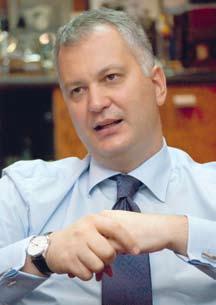
During Dragan Sutanovac’s term as Defence Minister, the Serbian military industry has concluded contracts worth $1.2 billion. In an exclusive interview for CorD, he reveals that preparations are underway for the construction of a hospital in Libya which will resemble the Military Medical Academy (VMA) in Serbia. The Minister also talks about the professionalisation of the army, the privatisation of military property, government reconstruction and the relations between the Serbian army and NATO.
At the last NATO summit in Lisbon, the leaders of the 28 NATO countries welcomed and supported “the pronounced commitment of the Serbian government in relation to Euro-Atlantic integrations and strengthening of the collaboration between this military alliance and Serbia”.
Your ministry received a lot of compliments at the summit. What does this tell us about Serbia’s current position?
In the conclusions of the summit, NATO commended the collaboration and expressed a wish to see Serbia establishing even tighter relations with the alliance. This is a great acknowledgement to everybody who is involved in thereform of the army in our country. Only several years ago, our army was far below the level of the modern armies of the world both structurally and training-wise. Today, we have a modern army that has been standardised in line with the highest global standards, which are currently the standards of NATO. All of our neighbours are already in the alliance or only a step from becoming a member. We cannot behave in a way that has no comprehension of the times and the security environment that we live in. On the contrary, we want to build up the strongest possible alliances. I would like to remind you that, back in 2006, we committed ourselves to Euro-Atlantic integrations. Our Parliament has made a decision that stipulates military neutrality, but this does not restrict the aspect of collaboration. While adhering to the parliament’s decision, we are also trying to strengthen relations via NATO’s Partnership for Peace Programme, which is in our mutual interest. Following the recent opening of an office in Brussels, we now have more opportunities to use the Programme’s capacities to a greater extent.
Is military neutrality sustainable long-term?
Neutrality is sustainable, but only in countries with a strong economy and countries that are able to organise their armies in line with the highest standards and provide the best possible military equipment. Neutrality is much more expensive, and our economy unfortunately cannot provide more money for defence issues. I would like to reiterate that the army is operating within the set coordinates, i.e. it is adhering to the parliament’s decision about military neutrality. At the same time, we are not lagging behind our neighbours, although we have not formed alliances with them.
Should Serbia change its political course toward NATO?
The most important issue is the standardisation of the army and the raising of our operational capacities. We want to meet all requirements in a proficient manner and this is for me, as the Defence Minister, the most important matter. We should not view future political decisions as a burden, since there is enough room to function properly even if we are neutral.
You have been very vocal about the Serbian army not only participating in UN peace missions, but also in those of the EU. What are your plans and what international importance does that hold for our country?
We have made a step forward and pleasantly surprised our EU partners by offering to participate in peace missions, which is not common for countries that are not EU members. In this way, we have gained some favourable points from the EU countries. At first, this initiative will only be a symbolic one, albeit quite important, since this is the first time in our history that we have participated in an EU-led civil mission.
What is currently being done concerning the participation in civil missions?
The Foreign Ministry is devising a framework agreement on civil and military missions with the EU, following which we will have a discussion in regards to future participation. The idea is that we will help the Greek or French fleets who have their ships stationed off the coast of Somalia. I believe that the Interior Ministry will also cooperate with the EU and take part in a civilian/police mission.
Are our staff qualified enough and suitably trained for such missions?
Of course they are! We have a great potential and energy and I am confident that, with the current pace of work, we are going to become an internationally respected factor in multi-national missions in a year’s time.
Seven of our soldiers have recently departed for Cyprus. Could you compare that number to the number of soldiers that are sent to other countries?
This is a rather symbolic number, but we are striving to participate with higher numbers. In addition to observers, we have a professional soldier in the mission for the first time ever. When this person applied for a job in the Serbian army, he probably couldn’t even have comprehend that, one day, he would be making history in terms of our peace missions.
Is the process of the professionalisation of the army going to be completed by late 2010, as you have previously announced?
Yes, it is! Although the plan for professionalisation was devised back in 2003, not a lot has been done since. Still, we are going to carry out this process as planned, i.e. as of 2011 the army will be made up only of professionals. By doing so, we are not abolishing compulsory military service, but are only suspending it while still giving the chance to anybody wanting to serve the army on a voluntary basis to do just this.
What effect will this have on the Serbian army’s budget and overall efficiency, both materially and operationally?
We are not going to have any additional costs, and we are going to spend a smaller amount of money on the professionalisation in the light of the Ministry’s budget in the last few years. We have carried out a serious analysis of the current costs of energy consumption, food, and military training and compared that to the costs that we are going to have in forming a professional army. With an identical budget, we are now going to have a professional soldier that receives a regular salary, who undergoes training just once and spends the rest of his career perfecting his skills.
You have said recently that one of the main operational segments of the Ministry of Defence is converting the military airports in La?evci, Batajnica and possibly in Ponikve. What are your plans apropos this idea?
Following the conversion, the idea is to extend these facilities to serve both civilian and military air traffic. The works have already begun at Morava Airport near Kraljevo, and next year we plan to start working on Batajnica. In this way, we are going to help our economy and provide a boost to these areas that are otherwise difficult to access.
Are these projects going to be realized with funding provided by the Ministry of Defence or someone else?
They are partly going to be funded from the Ministry’s budget and partly from the National Investment Plan (NIP). There is also the possibility of foreign donations. The Ministry will be the owner of these airports, and we are currently talking to Nikola Tesla Airport about the opportunity to operate the airports and to split the generated revenue in line with an agreed share.
You have been criticised for managing military property as though it was your own.
The only thing I can say is that the State Property Directorate manages the army’s assets. Those who criticise me do not understand how the system works, and they could blame me for climate changes for all I know.
Does the Serbian Army have a military assets registry?
We have been working a lot on putting such registry together and I cannot say with certainty when this process is going to be finished. In the 1990s, the state withdrew arms and military technology from the former Yugoslav republics. At that time, everything was done chaotically and, for two years now, we have been trying to bring order into that area. Also, we don’t have the appropriate software for this process, but we are doing our best to try and finish it. This problem is seldom considered a serious issue both by the army and amongst the general population, and your question is really a million-dollar question.
After you complete that process, are you going to privatise military facilities?
We are all aware of which army facilities ??? ?? no use ?? the army, and, together with the Property Directorate, we are mostly exchanging these facilities with the local authorities.
In 2009, the military industry exports reached a figure of $300 million, while the value of new contracts is close to $500 million. How much time is needed to reach the one billion dollar mark, which you have said is quite a realistic accomplishment?
Recently, we received confirmation that the last substantial contract, that we have been working on for over two years, worth $400 million, came to force. With this contract, and during my term in the office, Serbia has concluded a total of $1.2 billion worth of contracts. Exports have increased tenfold compared to a few years ago, and our military industry is now back on the pages of the most reputable military magazines in the world.
What is it that we are offering? What are we exporting?
Primarily ammunition. That is our trump card since ammunition is easily expendable. We also have howitzers and a training fighter jet called the Lasta, of which we are particularly proud. After several decades, we have finally managed to make and export such a jet, in addition to infantry weapons. In the future, aside from arms and military equipment, we are going to export know-how and medical knowledge.
Could you elaborate on this?
There is a realistic opportunity for us to build a hospital in Libya, just like our Military Medical Academy (VMA), but with a smaller capacity.
Are you preparing any new products for next year?
In early spring, we are going to start the serial production of an unmanned aircraft called the Vrabac. This is the combination of a civilian and military product. In the West, such aircraft are considered expendable. So, we are not going to be forced to buy this aircraft any longer, but are going to produce it ourselves and sell it to others.
Do you cooperate with military factories in the former Yugoslav republics?
We are cooperating with the Republic of Srpska, and, when it comes to certain contracts that are supposed to be concluded soon, we are going to have to engage production facilities in the region. In that context, it is very important for Serbia to become a centre that will gather forces together and initiate things. In the following few days, we are going to open a metalwork facility in Valjevo which will hire new workers and which is going to produce products that we have had to import in the past.
What are the most important markets that Serbia currently exports to, and, in your opinion, to which countries do we need to export more?
We are literally exporting from Malaysia to Canada to America, while most of our export activities are aimed at the countries of the Non-Aligned Movement, and lately at the North African countries. These markets could be sufficient enough for us, but there is a need to invest more in other markets and factories.
The project of the construction of affordable flats in the Belgrade quarter of Vozdovac is pending. How many of these flats will be given to army staff?
The Ministry will get 21% of the entire constructed area. This is one of the best infrastructural contracts that the Ministry has ever concluded. Bearing in mind that, so far, only 12% to 13% of the constructed areas in downtown Belgrade have been allocated, we consider this a really big step forward.
What criteria will be used for allocating the flats? How much will army staff pay per square meter and how much will civilians pay?
They are going to pay the purchase for these flats.
Could you describe for us the relations between KFOR and the Serbian Army?
They are exceptionally good, although we do disagree with KFOR when they say that there is enough room for them to reduce their forces in Kosovo. On the other hand, our problem is that an anti-NATO campaign is being orchestrated in Serbia, despite the fact that we want KFOR to remain in Kosovo. This is a situation that is difficult to comprehend, and where we, as politicians, do agree with the EU, but have a different approach to EULEX.
In that context, could we view this as another state’s interest?
Yes, we could. Kosovo and Metohija needs to become safe a zone with a developing democracy. All of us in the region are going to breathe a sigh of relief once Kosovo becomes a safe place to live. Currently, this is a safety zone that is engulfed in organised crime, human, drug and arms trafficking.
According to a recently published survey, Serbian citizens deposit most of their trust in the army.
Our army has restored its reputation. Today, this is the institution that Serbian citizens trust the most. It makes me really proud to be the person who leads the number one team. That is a big deal since, only six years ago, we were at the bottom of the list, so to speak, and riddled with problems. During my term in the office, there have been no affairs, no unexplained extraordinary situations or situations that are highly dubious, and this is something that citizens have recognised.
Speculations are rife about the Serbian government going through a restructuring process. Could you comment on that?
I am fortunate that our work can be statistically measured; hence I have no dilemma that we have fully completed the reforms in our defence system. If you look objectively at the work done by my team, you have to admit that the results are really fascinating. With regards to the reconstruction, the general agreement is that we are going to discuss that matter in more depth after the New Year. I expect those officials who are responsible for the government’s work to make a final decision.
You have a reputation of being a minister who doesn’t spend much time on personal promotion. Is that due to military security or is the reason an entirely different one?
If the system that I manage is yielding better results day-on-day, I see no need for personal marketing.
What do you expect from the upcoming elections in the Democratic Party?
I don’t expect any drastic changes to take place, but certain things are difficult to predict. Democracy is prevalent in the Democratic Party, and whoever fails to win over the trust of other party members, he or she needs to work twice as hard to come back. This has happened to me too, and I have managed to be appointed as the Deputy President.
How many days are you personally and the staff of the army going to be off during the holiday season, bearing in mind that, in Serbia, the holiday season starts at the end of 2010 and lasts all the way until mid-January 2011?
My team and I are engaged 24/7 and I have grown attached to the problems that our army faces. I will be in Belgrade both during the New Year and Christmas holidays.
