
27.02.2010.
Minister's interview to DANAS daily
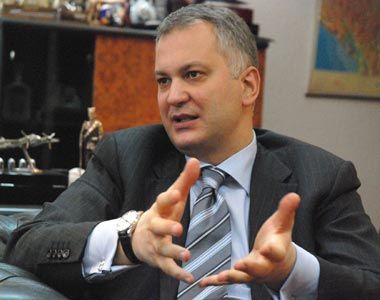
SALARY SHOULD BE DOUBLE OF THE NATIONAL AVERAGE
Serbia wants to be a leader in the region in the area of defense and security, and the professionalization process will give SAF a respectable position, as Defense Minister Dragan Sutannovac stated in an interview to DANAS daily. Reminding that the process started back in 2003, he adds that this was announced as the most ground breaking process of the government.
In the meantime all armies in the surroundings have undergone full professionalization. I consider this to be an adequate course the army has taken for many reasons. First of all, a professional soldier is equipped, and trained and ready to respond at every moment to all possible challenges that lie before him, as this is his profession. Professionalization will yield a more stable and safer defense system thus enlarging the security of our citizens.
What are the advantages of the professionalization?
We are at this moment spending enormous energy to train the last of the conscripts, where a six-month period of mandatory army service is just too short to make use of the conscripts and to use their knowledge. In this respect, the costs of a professional soldier will be lower, as he will undergo only one cycle of basic training during his career which means that there will be no additional expenses for accommodation, food and so on.
When do you expect to see the last generation of conscripts?
I hope that the December class will be the last.
What is the current interest in professional military career?
Young men have exhibited high level of interest. Last year we had four times more applicants than the openings available which proves that we have managed to restore the reputation of the army in the public. We can see the same trend in the mandatory military service. What should be noted is a high number of women applying for the position of a professional soldier some 12 to 15 %.
What are the concrete problems you face in the process of professionalization?
One of the main problems is insufficient media support at the national level, given that this is a very important process both for the army and the state. Furthermore, there are certain bureaucratic problems such as long security check ups of prospective candidates which hider and slow down this process. Nevertheless, the process if going as planned.
What is you message to the persons applying for the position of professional soldier?
What can they expect?
This is a steady yet very demanding and sometimes grueling job. Salaries are regular, and come with certain benefits. It is our goal to make the salary of a professional soldier twice the average Serbian salary. Unfortunately, this is not something we have achieved yet, as the salary is currently 27 000 RSD. Only when Serbia increases its participation in peace missions will this calling have its benefits as they will get paid well for a short period, while gaining excellent experience as peace missions require only the best trained soldiers.
Can we expect new deployment of SAF member in peace missions soon?
Currently we have 34 members in various missions in Chad, Congo, Cote d Ivoire, and Liberia. We are currently negotiating on new engagements of SAF soldiers. We strive to become a sort of a security exporter in he near future. We have military doctors in Chad and Congo which testifies to the high level of training of our doctors. Serbia is among few countries which trains officers who are doctors of medicine as well. How much we value this can be seen in the fact that MMA enrolled the first generation of cadets last year.
As for the number of employees in MoD have there been any changes, any downsizing? Changes with respect to obtaining higher ranks have also been introduced as part of the reform?
We started a painful reform, making a personnel pyramid, which is being established according to the highest standards. Higher ranks will no longer be a sure thing, something to be obtained depending on the years spent in service. People will have to be adequately educated and trained. An officer hoping to be promoted into the rank of a colonel or general will have to finish GS college, while the requirements for admission into a National defense School will be restricted. This is all for the purpose of having the best educated officers in the most responsible posts.
What will happen to those who do not meet the above said requirements?
For example, a Colonel with no adequate schooling will be offered either to get a position reserved for a Lt. Col. Or to get retired. A few years ago we had an illogical situation on our hands, with a slightly higher number of second lieutenants, lieutenants and captains than the number of colonels. Now we have reduced the number of formation posts reserved for colonels from 450 down to 150, while at the same time reducing the number of employees from 11.500 down to 8.500. It should also be noted that we have made some serious changes, where a number of generals and colonels transferred from GS to MoD and vice versa. This is done so we can make MoD and GS function as a team and not to have GS as a separate center of power. An officer who aspires to become a high-ranking officer has to go a long way-from deployment in a unit to occupying various posts in MoD in order to be able to get a complete insight into the functioning of the whole defense system.
The defense industry has made significant progress in the last few years. Can we expect some new contracts to be signed soon, and where will we export our weapons?
I believe that we are expecting new contracts to be signed all the time, and it is my personal opinion that we have the capacity to make better export income than last year. The most important thing is to have the factories working, that they offer jobs to people, and thus largely contribute to the state export. Our export focuses on Iraq predominantly, and we have plans to cooperate with the Algiers, Egypt, Kuwait and Libya, while at the same time negotiating with some European countries where we can offer our defense products.
What is the current situation in the Serbian air force?
Well, the situation is rather difficult. The technical equipment is rather obsolete. We have not seen new procurements for many years. A number of air crafts underwent complete overhaul such as air crafts type Galeb, MIG and Orao as well as helicopters. We have recently acquired new rockets for our air crafts. Of course, we can not talk seriously about an air force if we have pilots flying several decades old air crafts. Unfortunately at this moment amidst the world economic crisis a small number of countries can boast of having modernized their weapons and military equipment.
What are the priorities when it comes to purchasing new equipment?
We are in the middle of finalizing a new Procurement Plan. As a minister my job is to provide funds, while the professional part, the GS, decides what is necessary, therefore I can say that in my jurisdiction the priorities involve professionalization and the conversion of Ladjevci air field.
