08.01.2010.
Interview with SAF Chief of General Staff in the NIN weekly
In terms of security, the Serbian Armed Forces, in accordance with the political orientation, has the task to ensure the level of operational capabilities necessary for both neutral position and joining NATO, Miletic said.
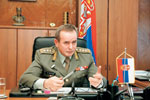 Lieutenant General Miloje Miletic, Chief of the Serbian Armed Forces General Staff, rarely appears in media. When asked why, he laconically replied that he considered it inappropriate to his function. “I don’t like to visit the units with journalists; I prefer doing it with my associates, experts in certain areas. When I pay a visit I want to see everything, I want a true picture.” He is aware of the position of the military, economic crisis and the restrictiveness of the budget. But, when asked what he would rather invest in if he were the one to dispose with and decide on big sums of money, he did not think too long. “If I had to spend it all, I would always choose the missile system, and if anything was left, then the housing would come up.” The interview for NIN was made in his office dominated by national flag and a bust of Voivode Živojin Misic?.
 You stated that the process of professionalisation of the Serbian Armed Forces would be completed at the beginning of 2011. What remains to be done?
Professionalisation can not be reduced to mere accepting people, putting them on the payroll, composing the contingent, believing that we have finished the professionalisation of the military. In 2008 and 2009 we have been intensively engaged in this work and it was not related only to the increase of the number of soldiers in units, but also to the creation of normative, legal and other documents in order to make it possible for transferring the system to the professional forces. It comprised a series of changes we had to make in the training system, because the training for professional soldiers looks much different than that for the recruiting contingent. I would like to point out that credit for all what has been done in the professionalisation of the Serbian Armed Forces does not only belong to the management of the Ministry of Defence and the Serbian Armed Forces General Staff but also to a range of young and skilled commanders and leaders who are making daily patrols in the security zone, perform exercises and firings, participate in international military exercises and in many other activities which added to promotion of our armed forces.
In 2010, we are going to admit about 4,000 new professional soldiers. This is what we will finish. But the professionalisation of the armed forces is not a thing for which you can tell to be completed in 2010 or in the first half of 2011, and to stop there. It is a lasting process because it includes the creation of units that characterise not only by numbers of personnel professionally employed in the military, but also by their commitment to do their tasks and their expertise. We will continue in this direction in 2010 and 2011.
How the economic crisis affects the dynamics of the professionalisation and equipping the armed forces with modern means of combat?
It is indisputable that the economic crisis affects the dynamics of professionalisation of the military, especially having the impact on the equipping and modernization. There is no doubt, but when talking to the Chiefs of General Staffs around the world, they will all emphasise the problem of money. So, if you ask me, as a soldier, about the things that I would like to see as a part of the newly introduced equipment in the armaments of the Serbian Armed Forces, then the list would be a really long one. But it is not just because we lack many things, but the fact is that we are witnessing the progress of military technology at a fantastic rate. Some military technology innovations can tremendously change the physiognomy of modern militaries. We have entered the process of medium-and long-term planning in developing and equipping the armed forces. And we do not see any more the priority in individual developing of military branches or services, but our main goal is to develop certain capabilities of the military. The public is more or less acquainted with our problems and our needs, but when we speak about the development of capabilities, we mean first of all the development of the mobility of our forces by introducing into service modern armoured combat vehicles – wheeled vehicles.
Another thing is to improve the protection of forces by purchasing protective equipment of general and specific purposes and upgrading the information technology used. When it comes to units, what we now have as a problem is the situation in our air forces. I cannot say that we have are seriously lagging behind, but in the near future, if we do not solve some problems, we will probably have serious gaps. Unfortunately, these are still consequences of the events of 1999 when we suffered the biggest losses.
What is better for the Serbian Armed Forces, to be neutral or to join NATO in the future?
The right question would be what is better for the Republic of Serbia. The issue of allying is the matter of the state, not the military, and the allies are to be determined by the state, not by the military. Current situation is such that the political structures have made a decision on it and the Resolution of Military Neutrality is in force. In terms of security, the Serbian Armed Forces, in accordance with the political orientation, has the task to ensure the level of operational capabilities necessary for both neutral position and joining NATO. When it comes to operational capabilities, it is not a secret that the countries which are members of NATO, so far progressed the furthest in terms of organisation, training management standards, operational planning and long-term development planning procedures. It is a fact. All the countries in our region and in the neighbourhood are NATO Members or Partners, with a tendency, or expressed aspiration to become NATO Members. Regardless of the political decision, our goal is to accept and develop the highest standards in our job. Therefore, I want to say that when they ask me if we train our officers according to NATO standards, although there are no NATO standards in place when it comes to training, I say - yes. But it is not because I am pushing or prefer our membership to NATO, but because I think that these are the standards that give the best results.
Defence Minister Šutanovac says that “it is better to send our soldiers abroad, than to be a host to foreign soldiers in our country.” Are our soldiers ready for missions abroad, to what extent, and in which specialties?
There is no doubt that participation in multinational activities has a significant impact on the development of a professional army. Because it is the place to gain a great experience, exchange the knowledge, while encouraging the development of skills. In this regard I fully agree with the Minister’s position. I must say that we have a very useful experience from the times of the JNA. The then army was a major exporter of security. And the experience from that time clearly shows that units which engage in international exercises or in multinational operations must be optimally trained and adequately equipped. Currently we have 34 members deployed in the peacekeeping missions in Liberia, Ivory Coast, Congo and Chad. Experiences from their engagement have only confirmed the previous findings. But multinational engagement does not assume only participation in operations. Last year, we were engaged in various ways in more than 20 multinational exercises. In all these exercises our officers proved to be trained enough to work on a par with officers from other armies. When it comes to units that could be employed, at the moment these are smaller infantry units, military police units, engineer units, CBR units and medical teams. These units represent a significant capacity for cooperation.
Have Serbian Armed Forces General Staff done their part of job in developing National Security Strategy and Military Doctrine?
The National Security Strategy and the Defence Strategy were adopted in the Serbian National Assembly on 26 October. The General Staff is obliged to develop the Doctrine of the Serbian Armed Forces and the deadline for its development is 90 days after the adoption of the National Security Strategy, which is on 26 January. The Doctrine of the Serbian Armed Forces is now under technical preparation for approval and it will be delivered to the President of the Republic in the days to come.
The most promising officers completed the General Staff School. How many of these officers are there in the Serbian Armed Forces today, and how many of them have been discharged from service on various grounds since 2000? Some of them, leaving the Forces have commented that they will not “embrace NATO but they would rather fight them again.”
I would like to emphasize that the advanced training of officers is not a question of emotions, but the question of acquiring the required professional standards. Our goal is acquiring the highest standards in our profession. Total number of formation positions for officers who completed General Staff College in the armed forces is around 150 positions, and our current numbers are at a satisfactory level. Since 2000, the average outflow of these categories of personnel has been about 5 persons per year. What sometimes can be a problem leading to a certain dissatisfaction is the fact that the completion of this school does not automatically mean obtaining a General’s shoulder strap. The role of education is to gain the professional knowledge and only those who are the best will put on the General’s shoulder strap. And it is the characteristic of a professional army.
How many officers who commanded the units at all levels during the NATO aggression are there today in the Serbian Armed Forces?
There are some speculations in a part of the public that all of the personnel who participated in 1999 war left the Serbian Armed Forces. I must emphasize that this is not true. Speculation with numbers is not the job of a Chief of General Staff. I think that it will be enough to say that all the officers who assume the most responsible positions in the Serbian Armed Forces today were commanders or deputy commanders of units at the rank of brigade during the war year 1999.
How do you personally feel when you see Zoltan Dani, the officer who shot the F-117, making bread rolls today?
During the NATO aggression, the F-117 aircraft was not shot by Zoltan Dani, but by the unit commanded by Zoltan Dani, and it can never be attributed to the individual. The things in the military and particularly in AD units simply do not work that way. There it comes to expression the teamwork. If someone wants to point out in all that their greater merits than the others, then there's something wrong. Of course, this does not apply to Zoltan Dani who was an outstanding officer during his career. I am pleased that we had such a professional in our ranks. I'm sure that Zoltan Dani has the same professional approach to his new business that he had while he was an officer, and that today he is an excellent baker.
Is it true that all the reports detailing the procedures of war units in 1999 were made available to NATO officers?
It is not true.
Compared to the armed forces of the neighbouring countries, where is the position of the Serbian Armed Forces today?
Any linear comparison is doomed to superficiality and generalization in advance. The equation of military power today cannot be simply expressed by the number of soldiers, tanks and aircraft. The question is more complex. The basic question is what they can do together. Let’s take, for example, Hungary that had 125,000 soldiers in 1990. Today their strength is about 25,000 soldiers. So, they reduced their actual strength by over 100,000 persons in less than 20 years. But I do not think that the armed forces of Hungary are ten times weaker than they were in 1990. On the contrary. On the other hand, what is interesting is the issue of professionalisation. Conscription has been abolished in all of our neighbouring countries except Albania. All of them have retained voluntary military service. Nobody has abolished the obligation of military service, but it is frozen, and will be activated in case of imminent war danger. This year I've met with the Chiefs of General Staff of all our neighbouring countries. And, I am sure that our forces are highly valued, not only in the region but also beyond. Our forces are not behind the forces of the neighbouring countries.
The hardest and the best things in the previous year?
There has been nothing in 2009 that I could attribute to myself as my own success because I see myself as a part of the team that worked on the restructuring and upgrading of the defence system. And, these are the serious tasks. There were really many moments last year when I felt a great professional satisfaction. If I still have to highlight something, then it would be the “Sretenje 2009” exercise, the Balkan CHOD Conference, the international military medical exercise of “MEDCEUR 2009”, the “Batajnica 2009” international air show, and the “Resolute Response” tactical exercise in Pešter. The day which was the hardest to me was on 7 July when our MiG-29 plane crashed and when our soldier Milan Ulemek and Colonel Rade Randjelovi? died. To me, professionally and personally, it was the hardest day not only in the last year, but in a longer period.
A hooligan soldier must be prosecuted
How do you comment on the fact that a member of the Serbian Armed Forces has been arrested as a member of a hooligan fan group who threatened a journalist Brankica Stankovi??
I am very proud to say that the military is a part of the people. I deeply believe that it is. In this case, the military cannot be isolated from all the sociological phenomena that occur in this society. Hooliganism in our sports facilities is a serious problem. One of our members has gone astray. He was arrested and I stand at the point that he must be prosecuted and if proven guilty should bear the corresponding legal consequences.
