
19.02.2009.
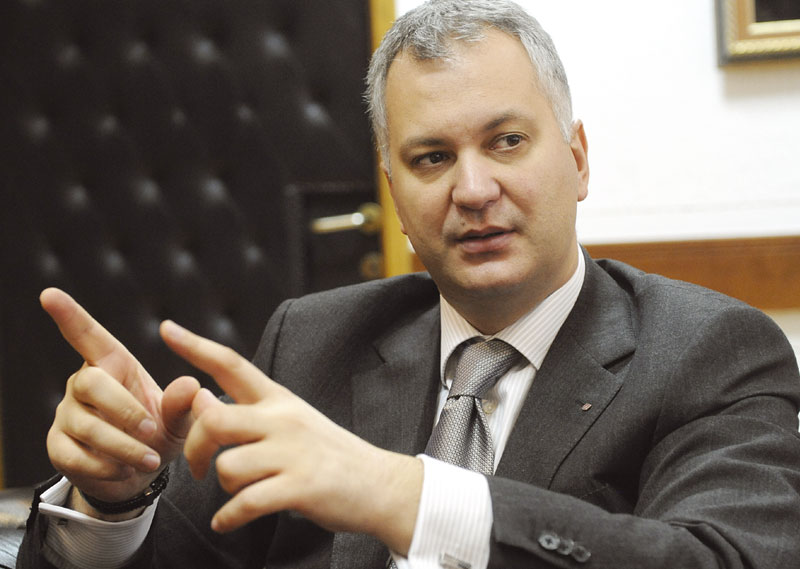
Minister Sutanovac's interview to "VREME" weekly
There are several hundred officers stationed in three brigades around Kosovo and many of these officers live there with their families. No one of these officers has made a single wrong move or has issued a wrong command. We have restored the trust of these people who are waiting for their superiors’ commands, even though we have had several rather tense situations. At this moment, we have 38 active generals, and we are paying 750 general pensions. It is a burden we have inherited from the previous period.
Author: Milos Vasic
On the day this interview was written, the Serbian Armed Forces had just got a new Chief of GS and a new deputy. These new appointments ended a period of transition after General Ponos was demoted in late December. The to-date Acting Chief of SAF GS LTG Miloje MIletic was appointed by the edict of President Tadic a new Chief of GS while General Mladen Cirkovic, who has so far been the commander of the army, became Deputy Chief. These appointments are in line with what Minister Sutanovac has stated in an interview to Vreme magazine: “The Army is a pillar of defense and it is only natural that its officers should in the future take the main command posts”.
The Serbian Armed Forces finally restored its old name for the first time after 1918, which is, as we hope, a final breakthrough from the previous decades. In a nutshell, the purpose of an army, according to Miodrag Zec, PhD from the Faculty of Philosophy, is to defend something or usurp something. Even though JNA (The Yugoslav National Army) ended WWII as a victorious part, it did not succeed in defending its country in 1991, which was destroyed by its own internal organizational paradoxes. JNA neither usurped let alone managed to defend anything. The time has finally come for Serbia to think it through, and define its own defense strategy and defense doctrine and to adjust its forces to the needs and risks of the modern times. The reform process started back in 2001 bearing a heavy burden In terms of ideology, politics, personnel issues as well as financial and technical problems.
DRAGAN SUTANOVAC: The strategy of defense is defined by the Constitution and the Strategy of National Security which defines the current threats, risks and challenges. This defines the defense interests, defense policy, a new concept of the defense system and according to these functions concrete details and finances are projected.
The defense strategy defines the interests of the Republic of Serbia: preserving sovereignty, independence and the territorial integrity as well as the safety of citizens, building trust, promoting safety and stability in the region as well as establishing successful cooperation with international security organizations and institutions of democratic countries. Serbia does not consider any country or alliance to be an enemy and is committed to contributing to the strengthening of global, regional and national security.
However, Serbia is determined to protect its sovereignty, territorial unity, and safety and to adhere to the constitution of Serbia and Serbia’s position that the autonomous province of Kosovo and Metohija is its integral part. Serbia is ready to take part in European security and defense policy and PfP thus strengthening its own safety.
Based on these goals of defense policy, risks and threats assessments, Serbia defines its defense concept. According to its concept, Serbia strives to protect its interests by deterring through a unified and effective defense system. This also includes a stable partnership, cooperation with the regional countries, participation in multinational operations in line with economic possibilities, as well as providing support to Serbia’s civil authorities in protecting internal safety.
This is the foundation where the doctrine of defense and the accompanying tactics stem from.
That is correct. A doctrine is defined as a group of established views regarding organization, preparing, deployment and securing of SAF. These views are formulated based on the assessment of the development of the current geopolitical, social, military security, scientific and other processes which define military activities such as: the physiognomy of armed conflicts, scientific and technical achievements and their military use, modern military doctrines, international relations and agreements, the state of SAF etc.
