29.04.2011.
Odbrana brings to you
NEED TO SHARE
Joint efforts in intensifying the sharing of intelligence information at the regional level means implementing a new paradigm- "the need to share" instead of the previous "the need to know”. Cooperation and respecting the interests of foreign partners contributes to the preservation of a favorable security environment and improving relations with neighboring countries and most influential.
 The Military Intelligence Agency (VOA) will mark its day on the 6th of May. That date, in 1920 the Intelligence Department of the Serbian HQ was first established and for the first time since the establishing of a modern army in our area, the intelligence agency was singled out as a separate organizational unit.
VOA today is part of the security intelligence system of Serbia, in which the Security-Information Agency and the Military Security Agency while the coordinating activities are performed by the Coordination Bureau.
VOA’s task is to support state and military leadership by providing intelligence information about the risks and threats from abroad against the security of our country.Therefore, it is "the first line of defense" against external challenges, risks and threats.
The Military Intelligence Agency is an important factor in the overall security of Serbia and a reliable partner in contributing to stability and security of our region. On occasion of the upcoming day of the agency, we started our interview with the Acting Chief of the Agency Brigadier General Dragan Vladisavljevic about regional topics
General, at the times when many security challenges are looming, from global to national, cooperation of intelligence agencies becomes more important. Intelligence Agency hosted the Second Conference of Military Intelligence Services Chiefs which adopted the first "Declaration on the Cooperation between the military intelligence services of countries of the region." How does this cooperation work?
- The progress that the countries of Southeast Europe have made over the past few years, with regard to European integration and the development of mechanisms for multilateral cooperation, positive effect on the security situation in the region. However, the perennial conflict, instability and isolation of the region led to the expansion of asymmetric threats that states can not, independently, effectively oppose and tackle. It is the shared risks and threats to the stability of the entire region which impose the need for a more intensive exchange of opinions and attitudes of their causes and consequences.
A major step in identifying the key security threats was made last year when it a Regional Conference of Military Intelligence Services Chief of South Eastern Europe (SEEMIC) was held in Belgrade. During the meeting we agreed on the attitudes about the possible causes of the security in the region and confirmed that it is necessary to strengthen mutual trust. As a result, nine heads of services, 12 of whom participated at the conference signed a Declaration of Cooperation. Although this document is not legally binding, it is an expression of willingness to improve cooperation. I must point out that it was agreed that all countries should combine efforts in intensifying the exchange of intelligence at the regional level, which actually means the implementation of a new paradigm - "need to share”, instead of the previous “need to know”.
How are the preparations for the third conference progressing? How motivated are certain states to cooperate?
- It should be noted that cooperation between intelligence services is a complex and sensitive job. Not SEEMIC members are equally motivated to cooperate, since they have already been engaged within the NATO, PfP and EU programs in various forms and levels of political and security integration. Yet the fact that preparations are underway for holding the third conference, which this year will be in Sarajevo is encouraging.
At this meeting we should discuss the mechanisms that would enable the implementation of the Declaration of Cooperation. The main topic will be defining procedures for sharing data from publicly available sources and initiate joint development of periodic news and analytical products. Intelligence Agency will, of course, try as always contribute to the success of these conferences and to the promotion of multilateral cooperation in the region through its initiatives and constructiveness.
Building trust is important to enhance the security and the mission of VOA. How would you assess the realization of this task?
- The Military Intelligence Agency, as a modern intelligence service, is trying to keep up with the contemporary trends, while making sure that Serbia’s security interests are not jeopardized. Accordingly, the military intelligence agency realizes cooperation with foreign intelligence services based on the goals of Serbia’s foreign policy and defense policy, as well as on its assessment of the importance of certain activities on defense matters, current political and security situation in the immediate environment, Europe and the world, the agency’s needs and the signed agreements on military and bilateral cooperation.
By cooperating with and respecting our partner countries, the members of our agency's strive to contribute to the maintenance of a favorable security environment and improving relations with neighboring countries and most influential states with their constructiveness and initiative. At the bilateral level, cooperation is carried in forms of visits of delegations at all levels, sharing information, carrying out joint operations and training personnel. We have reached a high level of cooperation with some agencies, all objectives have been successfully realized, and established contacts have contributed to a better monitoring of current security processes and phenomena, especially in terms of gaining insight into the attitudes and assessments of other countries on key security challenges, risks and threats to regional and global levels.
Where are our military delegations assigned and which countries have their military attaches accredited to our country
- Based on existing decisions of the Government of Serbia could have a network that could cover 42 countries of the world (30 on a residential basis, 12 the non-residential). However, the current network comprises 19 delegations of defense, with three accreditation on non-residential basis. We sent our DAs to eight neighboring and regional countries (Croatia, Bosnia and Herzegovina, Hungary, Romania, Bulgaria, Greece and Turkey) and six European countries (Britain, France, Germany, Italy, Austria and Spain) and to the three permanent members of the UN Security Council (U.S., Russia and China) and two countries in the region of Africa (Egypt and Libya).
On the principle of nonresidential accreditation we have DAs in three countries (the U.S.A. and Canada and Slovenia and Slovakia who resides in Austria). For this year we plan to open the delegation in Algeria and re-opening in Israel.
In our country currently has 28 defense delegations from other countries, in addition to our country is accredited eight states in the non-resident basis.
You regularly submit reports to the parliamentary security committee. What was the focus of the last report
- Intelligence Agency has an obligation to report to the Defence and Security Committee of the National Assembly, as one of the mechanisms of democratic control of the defense system. We act on this obligation very seriously, and we provide to the representatives of legislative authorities access to all relevant activities undertaken within our scope of work. At last report the focus was on the phenomena at the regional and global levels affect the security of our country, primarily on the situation in Kosovo and Metohija.
In addition, the report discusses the negative impacts of asymmetrical threats, such as ethnic and religious extremism. Also, in accordance with the foreign policy orientation of our country, there is a brief overview of the current affairs in the European Union, as this was our way of contributing to the preparation of our defense system for participation in the activities of the Common Foreign and Security Policy, especially in EU missions.
The Committee members are presented the activities undertaken by the VOA in the field of cooperation with domestic and foreign security and intelligence services, organizational changes and reforms in the normative-legal sphere.
What is your view of the downsizing of KFOR troops and from aspect of the security interests of Serbia
- International Security Force in Kosovo (KFOR) are conducting the second of three planned phases of reorganization and reduction in troops. Such decision is based on the need for engagement of NATO forces in other crisis areas in the world, like Afghanistan, and not on proper and favourable assessment of the current security situation in Kosovo Serbia would approve of. Although the decision to cut down KFOR troops is a clear sign of trust in the Serbian Army and its commitment to peace and stability in the region, it can have negative consequences in the sense that after the planned downsizing KFOR might not be able to respond to potential threats to security in Kosovo and support EULEX mission. Furthermore, the Serb population in the province is further concerned over plans by KFOR to give over part of their responsibilities to the Kosovo police and the Kosovo security forces.
The civilian democratic control will be implemented by introducing Inspector General service. What are your first impressions of this service?
- One of the prerequisites for operating under the jurisdiction of VOA is secrecy and confidentiality. This is precisely one of the reasons why the VOA and its work are under democratic civilian control. To this end, it is essential to follow and monitor all legislative, and executive power, and to the extent necessary and the public. Current legal standards ensure that the activities of VOA monitored and controlled through multiple levels and institutions. Its role in the supervision and control are: the Serbian National Assembly through the Committee on Defence and Security, Government through the Ministry of Defence and General Inspector, and certain forms of supervision of the Agency be able to implement the Ombudsman, Commissioner for Information of Public Importance and Data Protection personality and Auditor. In practice, it already does.
As for the Inspector General, he has already visited the VOA and met up with the organization and methods. Contacts with him are regular, and the first impressions are extremely positive and we believe that the function of the Inspector General provided a more reliable mechanism to control the security services in the Ministry of Defence.
Has the normative and legal framework been completed
- I would like to point out that in the previous period, normative-legal framework of the Agency has been completed. We have made all the necessary regulations for implementation of the Act on the Military Security and Intelligence Agencies (VBA and VOA, respectively). The regulations are harmonized, have all undergone the necessary procedures within the Ministry of Defence, and were discussed at the meeting of the Defence and Security Committee of the National Assembly. After their adoption by the competent institutions instructive documents and decisions were made, established according to the normative framework and adjusted to the modern requests for the functioning of the VOA. Of course, while drafting the legislation, we considered using the highest international democratic standards, recommendations and procedures. In any case, this was a big challenge for the Agency, especially because this was the first time that a legal and normative framework has been completed.
You are also engaged in the intelligence assessment of peacekeeping operations in which the Army of Serbia to take part. What are the results of the analysis?
- The Republic of Serbia is committed to developing a system of national security that is able to participate in the construction and improvement of regional and global security. In accordance with the legislation and foreign policy orientation of the state, the Serbian Army is developing the ability to actively contribute to the security environment and participation in peacekeeping missions under the mandate of the United Nations and within the European Union.
Intelligence agencies play an important role for successful engagement in peacekeeping operations. It was determined that a comprehensive and systematic collection of intelligence, adequate intelligence analysis and assessment affect the success of peacekeeping missions. In this context, the military intelligence agencies monitor possible trouble spots around the world, especially areas of potential engagement of the Serbian Army and other defense forces in peace operations. With this in mind we formed a database that includes information on almost all critical areas and current peacekeeping missions around the world.
One of the priorities of the Military Intelligence Agency is monitoring the situation in areas where our peacekeepers will be engaged. The Agency does not propose or select the peacekeeping mission where we will participate, butits assessments of the current situation affect the choice. For each of the peacekeeping operations proposed in the annual plan for the deployment of the Army of Serbia and other defense forces in multinational operations, the Agency has previously made an intelligence assessment.
What are the current activities when it comes to further strengthening of the VOA for the purpose of preserving national security and beyond
- The current VOA management sees the strengthening of the Agency, primarily as a continuous process of building and improving its intelligence capacity, which should enable the effective implementation of tasks in a complex international environment in accordance with the strategic goals and needs of the defense system of Serbia. To achieve this goal, we take sustained measures to strengthen the Agency's resources, human resources - through training of VOA, technical - by equipping with modern facilities and equipment, and infrastructure - through improved working conditions for all segments of the Agency. We also have "external resources". They are partners and the services we work with. Promotion of cooperation with partners enables capacity building through exchange of experience and training and without a doubt is a function of national security. Bearing in mind that, in relation to the number and character of modern challenges, risks and threats, available resources are limited, their efficient use is crucial for success in our work.
Achieving the aforementioned goals contributes significantly to the quality of the products of intelligence agencies, aimed at the state and military leadership, and in this connection we make special efforts to improve information-analytical work. I am convinced that military intelligence agencies continue to be a significant factor in security of the Republic of Serbia and reliable partner in contributing to stability and security of our region.
Radenko MUTAVDZIC
Photo by Jovo MAMULA
DEFENCE DELEGATIONS
Defense attaches realize their military and diplomatic position in the receiving country the accreditation country by performing the following tasks: representing and protecting the interests of the Ministry of Defence and the Serbian Army, negotiate with representatives of ministries and armies of the receiving country in order to promote friendly relations and developing international military cooperation with the state in they are accredited to.
Since defense envoys are an organizational unit of the Agency, VOA as the bearer of this task makes an assessment and proposes a network of defense delegations, of course, with regular consultations and agreements with the Sector for Defense Policy and taking into consideration the opinion of the General Staff of the Serbian Army and the Department for Material Resources.
Furthermore, we take into account the economic and financial capacity of the state, i.e., the army. Finally, the Government adopts a Conclusion on the adoption of the proposed network of defense delegations and charges the Ministry of Defense, in accordance with its responsibilities, to define the organization and composition of the defense delegations.
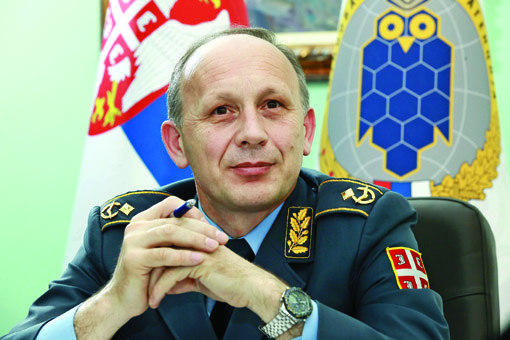
We made this interview with the VOA Acting Chief Brigadier General Dragan Vladisavljevic before his departure on Batajnica, to make another flight on MiG 29.The general's pilot career began in1985 when he graduated from the Military Academy, where he was top of the class. He has held various flying and staff duties in the 204th fighter aviation regiment from 1985 to 1996, and in 2000 he was appointed deputy commander of the air force.
He completed his General Staff School (1996), again as top of the class, and in 2002. he finished the School of National Defense. He was a defense attaché in Turkey from 2005 to 2009, when he was made the first man of Military Intelligence Agency.
ASSESSING PEACE MISSIONS
In order to answer the question on assessing peacekeeping operations, it is necessary to perform a complex intelligence analysis. Numerous factors are taken into account, among which I particularly single out the current political and security situation and security risks and threats to peacekeepers in the zone of operations. In addition, we discuss the modalities of engagement from the aspect of the national contingent’s structure. The point is to successfully perform all assigned tasks with minimal risks to the security of our peacekeepers.
Of course, there is no ideal intelligence assessment, because it is an engagement in the areas where the roots of the crisis are so complex, that some communities are under constant risk of the resurgence of the armed conflict.
