15.03.2011.
Minister Sutanovac at the Meeting of the in Southeast European Cooperation Process – SEECP
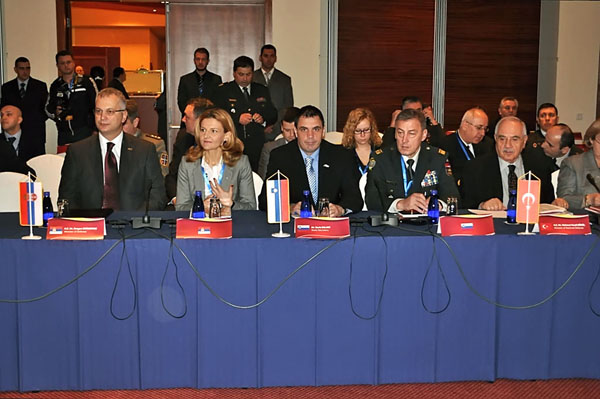
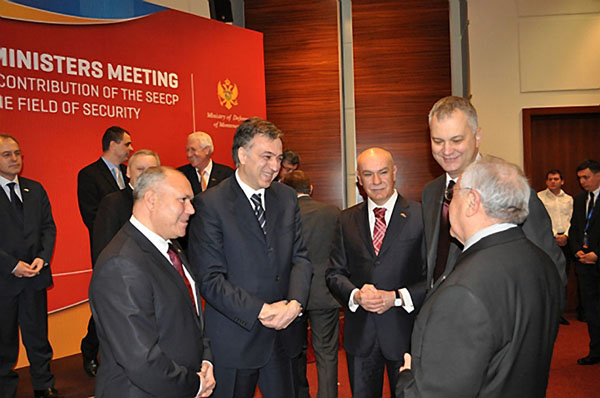
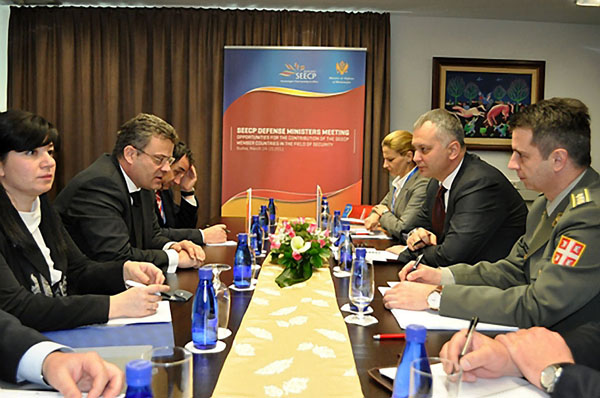
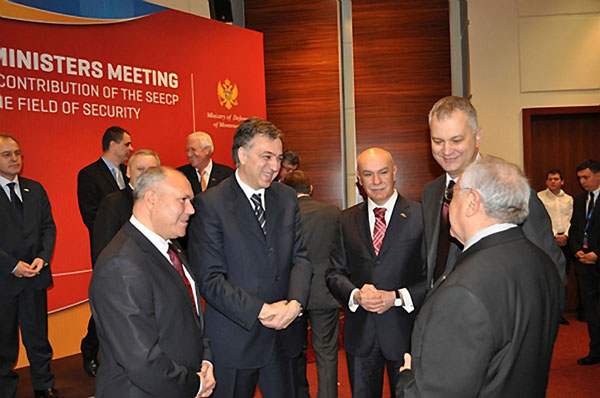
Defence Minister Dragan Sutanovac participated in a two-day ministerial meeting of the Southeast European Cooperation Process – SEECP, which was held in Budva.
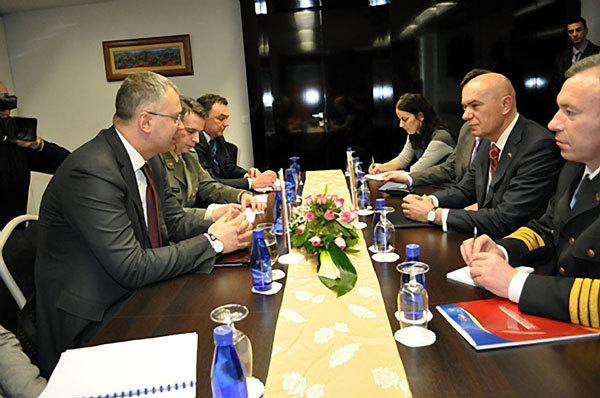
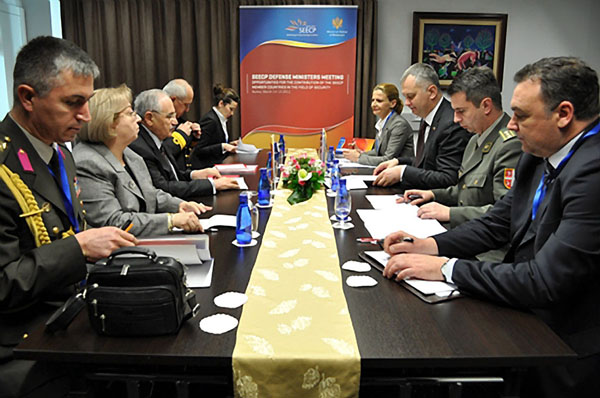
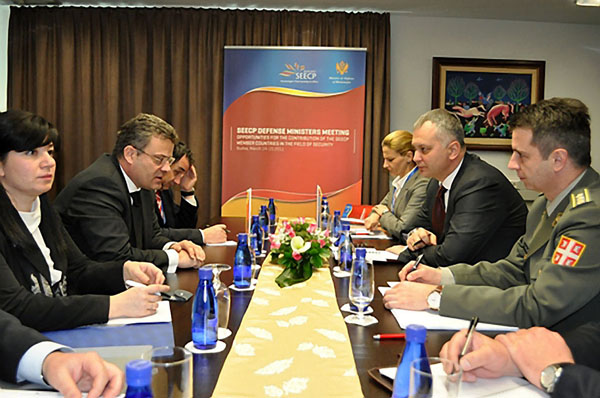
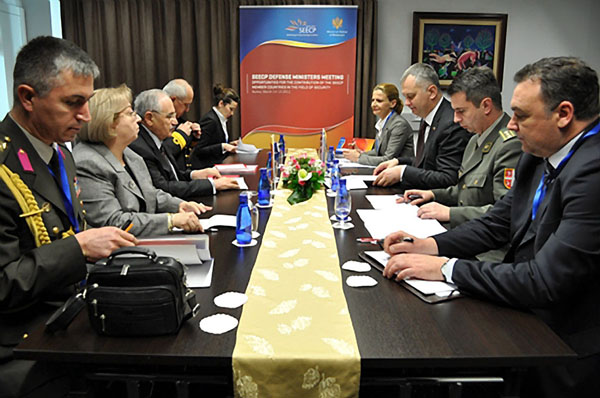
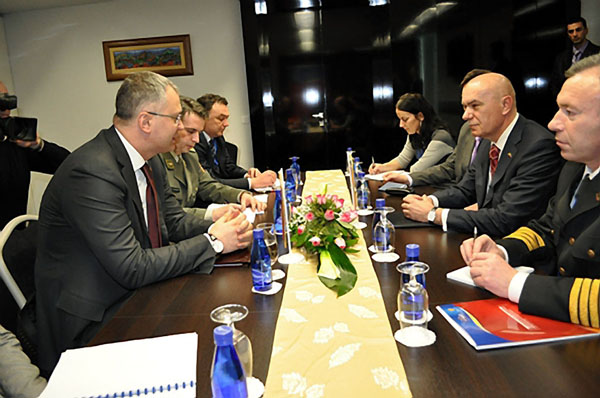 During the meeting Ministar Sutanovac also had bilateral meetings with his counterparts from Montenegro, Boro Vucinic, Turkey, Mehmet Gonul, and Albania, Arben Imami.
 SPEECH BY MINISTER SUTANOVAC
I wish to emphasise how pleased I am with the fact that a defence ministerial meeting is organised under the umbrella of the Southeast European Cooperation Process. The defence and security issues make an integral part of regional cooperation and we should use every opportunity to discuss the topics of vital importance. Let me remind you that Belgrade will be the host of the next defence ministerial meeting in spring 2012, during the upcoming Serbia’s presidency of this initiative. I expect that you will accept our invitation so that we can continue the initiated dialogue in this format.
Dear Colleagues,
We can all be proud of the fact that the South East Europe achieved very good results in promoting the regional cooperation. This conclusion can be drawn from many facts based on the results of improvement of bilateral relations in the region and of the work of regional initiatives. This fact is even more significant bearing in mind that it was exactly two decades ago that a 10-year long series of conflicts and wars began in the western Balkans, taking many victims and bringing about consequences that are hard to perceive even today.
 During this 2011 we have had results supporting the fact that cooperation in settling disputes and problems has no alternative. If we take the example of Serbia, only in terms of bilateral relations in the field of defence with the year 2010 inclusive, we rounded up the agreement relations with all the countries in the region, except for Albania, which we are going to work on in the near future. Serbia takes part in the work of all regional initiatives, and in 2011 it will preside over three of them – the Central European Initiative, Adriatic-Ionian Initiative and the Migration, Asylum and Refugees Regional Initiative (MARRI). The Ministry of Defence, under the auspices of the South-East Europe Clearinghouse (SEEC), will organise the first regional conference in the field of military medical cooperation in the period from 26 to 29 April 2011, and the 11th SEEC annual conference in the period from 25 to 27 May 2011. One of the biggest events organised by the Ministry of Defence this year will be the Strategic Military Partner Conference, to be held in Belgrade from 13 to 15 June. I hope that the SEECP chiefs of staff will take part in this event. Also, in 2012 Serbia will chair the Organisation of the Black Sea Economic Cooperation. With this in mind, it can be considered that 2011 and 2012 are important for Serbia's role in strengthening regional cooperation. We are glad because the European Union has also recognised this fact by commending the efforts being invested by Serbia on the regional level in its reports. We are particularly proud of the fact that the EU has welcomed the reforms in the defence sector and the professionalisation of the Serbian Armed Forces in particular, which entered into force on 1 January 2011 and is perceived as an important step towards the modernisation and further strengthening of the civil democratic oversight of the armed forces.
  Despite evident improvement of regional spirit and cooperation, we should not ignore the obvious problems. Apart from the unresolved status of Kosovo-Metohija, the region is burdened with the problems of underdeveloped economies and a high percentage of unemployment. Other problems are also high level of corruption, organised crime, trafficking in humans, drugs, weapons and organs, unresolved issue of return of refugees and internally displaced persons. Unsatisfactory quality of life of citizens should be the primary concern of us politicians, since our main job is to ensure the wellbeing of the citizens. All these are major challenges for every society and country in the region and for the region as a whole.
 Of course, every challenge should be seen primarily as a chance to solve national problems and to strengthen regional cooperation. Encouraging is the fact that there is high awareness in the region that security is indivisible whole, and that only through regional cooperation and the initiatives such as SEECP it is possible to achieve overall prosperity. A particularly encouraging fact is that SEECP is completely “regional ownership” arisen from the need for finding the region’s response to regional threats.
 The entire region shares unambiguous commitment to membership of the EU. The regional cooperation is a key segment of the attitude of the EU towards the Western Balkans because the EU itself was created through the development of regional cooperation. However, it is important to emphasize that we do not see regional cooperation as a condition for the EU membership, but as an end in itself. Only with mature and self-critical attitude towards ourselves and others, we can expect progress for all of us. Serbia recognizes and implements it through its policy demonstrating it through its constructive approach shown in the initiated dialogue between Belgrade and Pristina in cooperation with the European Union, and its support to European and Euro-Atlantic aspirations of the countries in the region.
 We expect that by the end of March, the Security Agreement with the EU and the Agreement on the participation in EU-led missions will be signed, which will enable us during this year to commence our participation in EU-led missions for the first time in the history, in addition to the participation in UN-led peacekeeping missions. We hope that we will obtain the EU candidate status and that the date for starting the membership negotiations will be determined by the end of this year. We believe that European agenda of the Republic of Serbia for 2011 is ambitious but realistic.
I am deeply convinced that the current decade will be the decade of the Western Balkans, and of the successfully completed reforms and European integrations.
 PHOTOGALLERY