
15.11.2010.
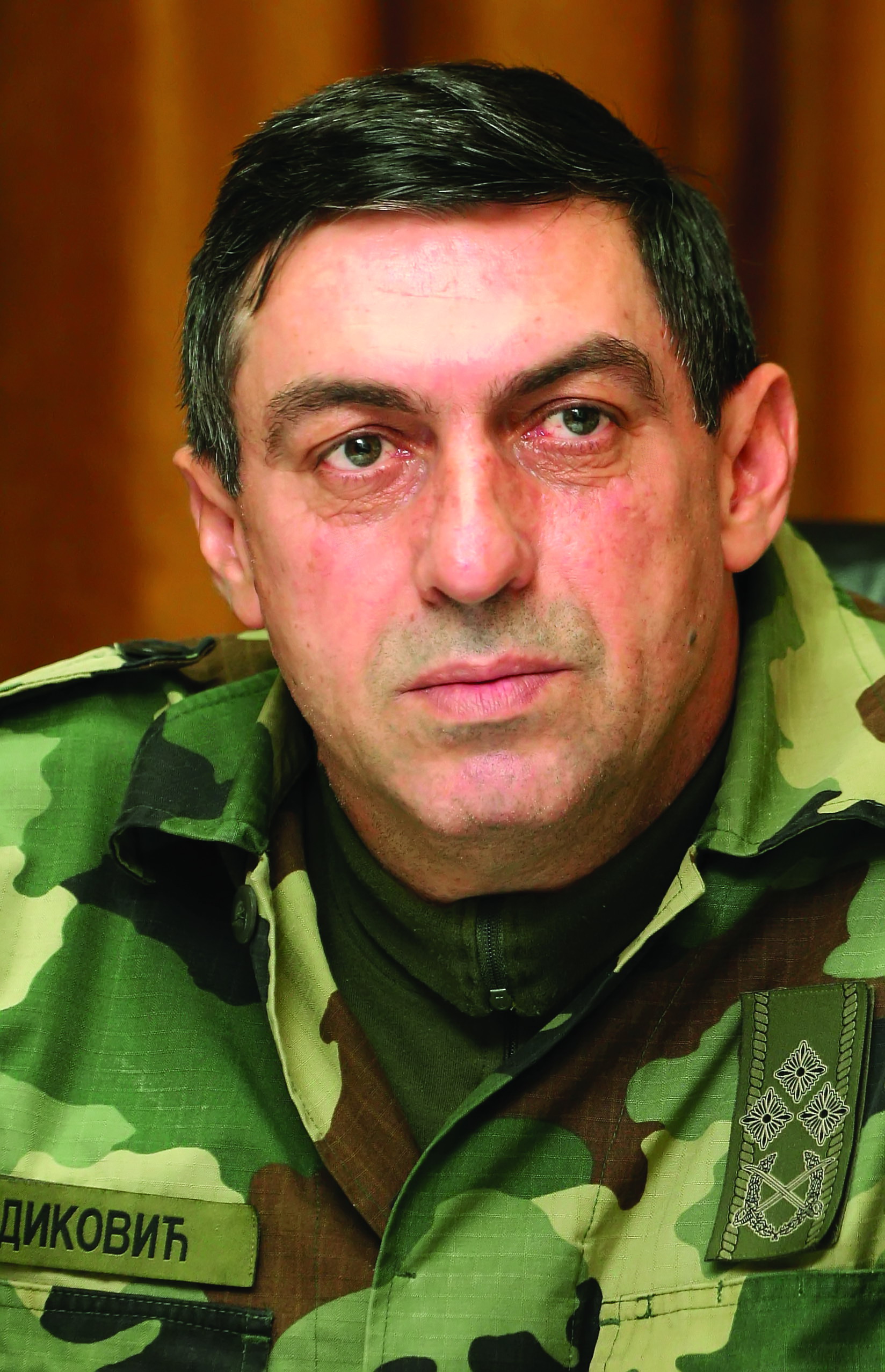
General Dikovic's interview to ODBRANA
We have currently some 90 % of professional soldiers in our ranks, which signals that we are approaching the realization of strategic objectives and commitments. We have seen a dramatic rise in interest for the military profession this year, so that we have had as many as 10 candidates applying for one position as LTG Dikovic, Commander of the SAF Army, said in an interview to Odbrana magazine on the occasion of the 16th November-the Day of the Army.
 At the beginning of the interview, General Dikovic highlights the support the SAF 2nd brigade has been providing t the citizens of Kraljevo following a devastating earthquake which hit Kraljevo and its surroundings, in evacuation, providing relief and creating conditions for normal life of the people in the area and repairing damaged buildings. This means that the Second Brigade units are directly and effectively engaged in the realization of tasks of the third mission of the Army of Serbia (civil-military cooperation).
The military facilities in the barracks "Ribnica" and "Jovan Kursula are also damaged with only two building functional for use, while others are not fit for housing. The Garrison clinic in Kraljevois also not functional. The damage caused to military facilities is extensive and is estimated at some 120 million RSD.
- We provide assistance primarily by supplying Kraljevo with water, by clearing debris and rubble and repairing and covering of houses and buildings, both in urban and rural areas – as General Dikovic states. – Some two hundred officers and professional soldiers are engaged on daily basis, not counting those on mechanization. Twenty military trucks are transporting materials from other towns in Serbia to Kraljevo, while ten water tanks are used continuously. We are constantly apprized of what is happening in Kraljevo, as a member of the Second Brigade is also a member of the crisis HQ, from there we coordinate activities of all structures, particularly the participation of military personnel in the repair of earthquake consequences. We do not strive for any rewards, but I think we have once again proven that we are always there when the going gets tough and the people in Kraljevo have recognized this.
Professionalization of the Army units is coming to an end. What changes can expect starting next year, when the Army units will be manned only with professional soldiers?
We have currently some 90 % of professional soldiers in our ranks, which signals that we are approaching the realization of strategic objectives and commitments. We have seen a dramatic rise in interest for the military profession this year, so that we have had as many as 10 candidates applying for one position.
This interest has led to getting the best pick of the candidates. The total number of professional soldiers admitted is now 2050, which has positively affected the operational capabilities of the Army.
We admitted 300 professional female soldiers, who have undergone professional training thus demonstrating they can complete the training as successfully as their male colleague. With professional soldiers, we have made a progress in terms of quality training of men which will enable us to get a committed soldier, who can stand side by side with professional officers and noncommissioned officers and perform other tasks.
The professionalisation of staff has significantly improved performance and the operating of war technical equipment, improving the organization of internal services and opening new possibilities for properly selecting men for more duties in training and practice. It is important to know that we do not consider the professionalization as a process of only manning our units with professional soldiers, but we rather look beyond this, as we have many other tasks in the next year such approximating our army to the standards we have accepted and making changes in training.
The exercise "Joint Endeavour "on Pasuljanske livade training ground is the first exercise in the history of the Serbian Army to have involved solely professional staff.
- What we saw in this exercise was, in fact, a model of how all this would look like in the future and how to realize a complex exercise, difficult to organize and very complex in terms of predicted content. All the activities in the exercises were conducted with ordnance and the results were really above our expectations. This is something we strive for in the training of professional soldiers for the first mission and this will serve as a sort of guideline for the upcoming period.
Soon first sergeants, as first professional soldiers, will arrive in these units.
- We had a system of training for NCO duties, that we abandoned in previous years, since we estimated that this way of education was not the best one and that there were other ways of getting quality non-commissioned officers. Professional soldiers will serve as a solid basis for new NCO corps in SAF, as they have spent some time in units of the army, and have at the time showed and proved their leadership skills and the ability to command.
The army has selected among the most experienced professional soldiers according to strict criteria the best 46 candidates and has sent them to a basic NCO course, which is being organized for the first time in the Serbian Army, and I am pleased to announce that we are just a few days away from seeing the first generation of professional soldiers who have completed the predicted training modules. What we now know is the attendees of this NCO course have shown very good results, have mastered skills of leaders and that the methodological skills for the trainer. Other skills will be obtained in practice in commands and units of the army.
How do you rate this year's collaboration of the Army units and commands with the members of the armed forces from other countries? You stated that the participation in international military exercises is the best way to prepare for the second mission?
- Any army that used to isolate itself from other armies did not fare well. We must cooperate with others, check our abilities and compare with others. In 2010 the international military cooperation in the Land Forces has been very good and intense. With the members of the Ohio National Guard we have realized the training of declared units in the “Jug” base. Special units underwent training with the special forces of Greece, Italy and Turkey. Furthermore, we performed several exercises with the members of the armed forces of Romania, USA, Hungary, Austria, Bulgaria and Macedonia. These activities have greatly contributed to understanding the place and the military's role in modern economy and training of units that participated in these exercises.
Just a glimpse of the soldiers who have participated in international military exercises leads to a conclusion that the soldiers of foreign countries are no superior or better or more prepared than our soldiers. They may have better and more sophisticated weapons, but as far as the knowledge, willingness and capability go, our troops are even far better in certain segments.
Do have a sufficient number of organized forms of training and preparations for such activities with other armies?
- Intense international military cooperation is inevitable and necessary. It is inevitable, since only through cooperation we can respond to modern challenges, risks and threats, and necessary because it is enables us to acquire new knowledge and share experiences. In order to improve such cooperation, it is essential to know foreign languages, because not knowing a certain language is a sort of a barrier. The military has recognized this, and we have worked out a strategy for learning foreign languages which is already yielding good results.
How do you prepare for the possible execution of tasks in multinational operations, when the competent authorities decide on such an engagement?
- Serbia’s opting to participate actively in regional and world conditions the Serbian army to be ready for such challenges. If the authorities decide on the participation of our combat troops in such missions, the Army will continue to fulfill its tasks as it has done so far, as it is the bearer of several important activities of the partnership we have committed ourselves to.
We are preparing a motorized infantry battalion to participate in multinational operations, in two rotations. Currently we have one company in Zajecar and Raska each undergoing training for participation in multinational operations. The company in Zajecar, as the first to be declared for participation in multinational operations, has completed individual and is now in the process of collective training. The company in Raska has completed individual training and is now in intensive English language course. The results achieved are very encouraging, and after successful completion of both individual and collective training, the individuals and the units alike will get a certificate for participation in multinational operations.
Do these units for multinational operations have adequate weapons and equipment?
- The Land Forces Command has taken measures and as focused on equipping the units with adequate weapons give that they are preparing to participate in multinational operations. We have changed the main weapons and have substituted old weapons for with guns 5.56 mm M-21 while also introducing modern telecommunications equipment in accordance with the required standards. Our intentions are to reach the necessary level of interoperability with other units in a multinational environment. Further equipping is through procuring personal combat equipment and protection equipment, modern terrain and transport vehicles and optoelectronic devices.
When it comes to weapons and equipment in the Army, let me remind you that most of the combat system entered the use in 1980s. And that is our most recent equipment. Part of these systems is, regardless of the time they were introduced, and still usable and efficient. Here I mean the artillery systems and tanks and M-84, which will not be considered as obsolete for a long time, and we are on the right track to modernize them. What we need most are vehicles, air defense systems, telecommunication equipment and equipment for soldiers according to the model M-21. Patience is a virtue, and it is clear that at this point we cannot expect more, but perseverance and hope is what remains.
Securing the administrative line towards Kosovo and Metohija works, apparently, with no problems. Has the “Jug” base brought some improvements?
- The situation in the Ground Safety Zone in southern Serbia can be described as stable, but you never know when the threats to security can occur which is we take all necessary measures. We have very good cooperation with KFOR and have developed good relations with the locals in the GSZ. We provide assistance in building roads, setting up bridges, transportation of the sick and the disabled in such campaign as the "Village Doctor". The residents of the GSZ are extremely satisfied with the military and we are a force which brings stability to the area.
"Jug" military base has improved the working conditions for the soldiers who are tasked with securing the administrative line, and thanks to it we have managed to rationalize the use of force, as this created conditions to relocate the Fourth Brigade of the Army from Leskovac to garrisons in Vranje and Bujanovac. It is very important in military geographical terms and from this base we can be successfully handle every task in the Ground Safety Zone.
How would you assess the material and social status of the Army?
- The material and social status of our officers and soldiers is very important and it is reflected in all aspects of operational capability and cannot be ignored. Fortunately, the Ministry of Defence and General Staff of the Army of Serbia are making efforts in this field, so we have seen a certain increase in the standard of our members by raising the salary quotient for those engaged on complex and risky tasks. This is the best we could do at this moment. I expect that next year the situation will be better and that the standard will come closer to the standard of our soldiers in other armies.
I would like to stress the fact that 80 percent of the Army has already resolved the housing issue. As for the loans we are reluctant to tae loans because of the instability of the domestic currency and the fact that salaries are frozen.
We make progress in other domains. Housing conditions of our soldiers in the barracks are favorable, food is extremely improved, and now we will, later this year, and solve the issue of procuring thousands of new uniforms for our soldiers. We plan to complete the uniforms next year.
General, can You tell us how You plan to celebrate the Day of the branch-of the Army?
- The Army, as is well known celebrates 16th November as its day, as the day when, after the regrouping of forces, an offense stage in Kolubara battle started. This is one of the most significant dates in Serbian military practice.
We usually tend to think of General Misic when we think of this brilliant victory of the Serbian Army and his ability to evaluate the situation to make the best decision at that point.
Yes, it's true, had it not been for such courageous, bold and determined soldiers, NCOs and officers to put his decision in the action the question remains whether his geniuses as a commander would have been confirmed. This is a typical example of the collective victory from soldiers to general. Creating such groups and teams is a challenge in itself.
