30.05.2009.
LTG Miletic's interview to NOVOSTI
SERBIA CAN REMAIN NEUTRAL
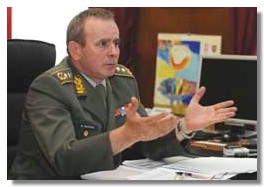 The global economic crisis will not stop the reforms of the defense system. As president Tadic has announced, we expect our army to be fully professionalized by 2011. Due to the economic crisis, some deadlines will be prolonged, the modernization and equipping will be slowed down, yet the standard and the training of our personnel will not suffer the burden of the crisis, as LTG Miloje Miletic stated exclusively in his first interview to Novosti daily since his appointment as the new Chief of SAF GS.
When asked how the army has fared in the whole budget cutting process, General Miletic explains:
The salaries of the members of SAF have not been reduced, yet the budget has suffered significant cuts, by 5.1 bn RSD. We are fully aware that the army has to share the faith of its country, yet we must bear in mind that each crisis requires the security measures to be increased, since crisis always result in a rise of crime rate, corruption, and terrorist.
threats.
What did you tell the President of Serbia during your latest report to him-what are the current security threats?
Even though the security in the region and Serbia is at a much higher level than in previous years, it is still largely affected by the heritage of the past. Nationalistic, religious and political extremists, in addition to the ongoing economic crisis, are weighing heavily on the ongoing democratization and transition of all Balkan countries. Our biggest security challenge not only for Serbia but for the whole region and even Europe is the attempt of Kosovo’s secession.
Are Kosovo security forces a threat to Serbia?
Some 2500 members of the Kosovo Security Forces armed mostly with light armaments do not pose a threat to our country at the moment. However, in the long run, this can be a potential source of instability in the future. Forming new armed formations, not proposed by the UN 12344 Resolution, nor by any other international agreement, disturbs the balance of powers in these territories.
What are the problems you encounter in cooperation of SAF with KFOR?
There are no problems in cooperation. Till two years ago, that is, until the decision for KFOR to be engaged on forming Kosovo security forces, we had been holding meetings at all levels, conducted joint patrols along the administrative border line, conducted several exercises, and even had joint sports meetings. We are still realizing all planned activities, except for high-level meetings, between the Chief of SAF GS and the KFOR commander.
A few months ago, the Minister of Defense revived the question of canceling the ground and air safety zone. According to Your information, is that possible in the upcoming period?
There are ongoing political consultations on redefining the military-technical agreement with KFOR. Yet, we cannot predict when this will happen.
Is the army ready to take over full control over GSZ?
We are ready. SAF has its forces stationed in GSZ. The necessary preconditions for its cancellation have been met, yet the circumstances in the previous 10 years have changed.
We have started as opposing sides to become partners in this region.
What does the Strategy of National Security, recently adopted by the Government, envision?
These are our top strategic documents which regulate the system of defense. They define the security environment regionally and globally, potential threats to the security of the country, and defines the missions and tasks of SAF. After these documents are verified in the Parliament, we will adopt of SAF doctrine, which will finish the legal-normative framework for the army’s functioning.
What is your comment to the critics that these documents do not explicitly say whether the country should enter NATO or should remain neutral?
The army adheres to the Parliament’s decisions, so the changes in this respect are also under the parliament’s authority.
Is it possible for one country to remain neutral in the current balance of powers?
That is a political question. Yet, I believe that it is possible. This is confirmed by the fact that there are countries which are not members of military alliances, yet are actively involved in the collective security system.
On the other hand, the top state officials are calling on intensification of Partnership for Peace Program activities. Minister Sutanovac, during his meeting with Vice President Buiden also suggested this…
First of all, it is my opinion that Biden’s visit to Serbia is of great importance for the position of our country in foreign policy. However, the involvement in PfP does not clash with our military neutrality. All national interests and objectives ion the area of defense can be realized within PfP. Security is becoming a global problem. The countries’ needs to get involved into one collective security system are growing.
What are the benefits Serbia can get from PfP?
PfP participation is a state, not a military project, yet a number of ministries are participating in the project. As far as SAF is concerned, we are cooperating in those areas necessary for the conducting reforms, such as training, education, and joint exercises, as well as the modernization and equipping of our army. These activities strengthen our capabilities in terms of interoperability.
Where are our officers getting their education?
In USA, Great Briatin, France, Germany, Italy, Turkey, Greece and Russia…. We are planning to open our MLO office in NATO HQ in Brussels which should open up new possibilities for further involvement of our country into PfP.
You have just returned from the meeting of the army chiefs of the American-Adriatic Charter. What was the main topic of this meeting?
The members of the initiative are Albania, B&H, Montenegro, Croatia and Macedonia where Serbia has the observer’s status. This purpose of this Charter is to add to European stability and safety and to improve regional cooperation. There was also the discussion about the participation of member states in peacekeeping missions.
Which UN peace support missions do SAF members take part in?
Our members are currently engaged in three missions: Congo, Liberia, Cote d Ivoire with 13 men. We are also in the process of engaging our medical team in the peace mission in Chad as part of the Norwegian contingent.
